Pottstown Water Hardness: What 150 to 220 ppm Is Doing to Your Plumbing
Pennsylvania American Water's Schuylkill River source delivers hard water to Pottstown at 150 to 220 ppm. Here is what that hardness number means for your water heater, fixtures, and appliances, and how a softener addresses it.
Where Pottstown's water comes from and what it picks up
Pennsylvania American Water operates the Pottstown surface water treatment plant, which draws raw water from the Schuylkill River. The Schuylkill carries dissolved calcium and magnesium from the limestone-rich geology of its watershed upstream of Pottstown. After treatment, the finished water entering the distribution system runs at approximately 150 to 220 parts per million (ppm) of dissolved calcium carbonate, which is the standard way water hardness is expressed. In the older unit of grains per gallon, that is 8.8 to 12.9 grains per gallon.
For context, the US Geological Survey classifies water over 180 ppm as very hard. Pottstown's water falls in the hard to very hard range depending on the season and the Schuylkill River's conditions. This is not a health concern; the calcium and magnesium in hard water are minerals the body needs and are consumed in water at levels well below any threshold of concern. The impact is entirely on plumbing systems and appliances.
What hard water does to your water heater
Water heaters are the most significantly affected appliance in a hard-water home. When hard water is heated, calcium carbonate precipitates out of solution and deposits as scale on the heating surface. In an electric water heater, scale coats the heating elements, insulating them from the water and forcing the elements to run longer and hotter to reach the set temperature. Scale on an electric element accelerates element burnout significantly.
In a gas water heater, scale deposits on the bottom of the tank, between the burner below and the water above. This scale layer insulates the tank from the heat and reduces efficiency in the same way. The scale also creates hot spots on the tank bottom that can cause premature tank failure. Tank popping or rumbling sounds during heating cycles are scale building up and breaking loose on the tank bottom.
Tankless water heaters are particularly sensitive to hard water because their compact heat exchangers concentrate scale in a very small space. Tankless units in Pottstown should be descaled annually to protect the heat exchanger and maintain efficiency. Neglecting tankless descaling in hard water can void the manufacturer warranty and shorten the unit's life significantly.
What hard water does to fixtures and appliances
Scale accumulates on shower heads, faucet aerators, and around drain openings, producing the white crusty deposits that are the most visible sign of hard water in a home. Clogged aerators reduce water flow at individual fixtures even when supply pressure is adequate. Showerheads clogged with scale produce uneven spray patterns and reduced flow.
Dishwashers and washing machines in hard water areas accumulate scale in heating elements and interior surfaces. The mineral deposits also reduce the effectiveness of detergent and soap, which is why hard water produces poor lather, film on glassware and dishes, and a film sensation on skin after bathing.
How an ion-exchange water softener addresses the problem
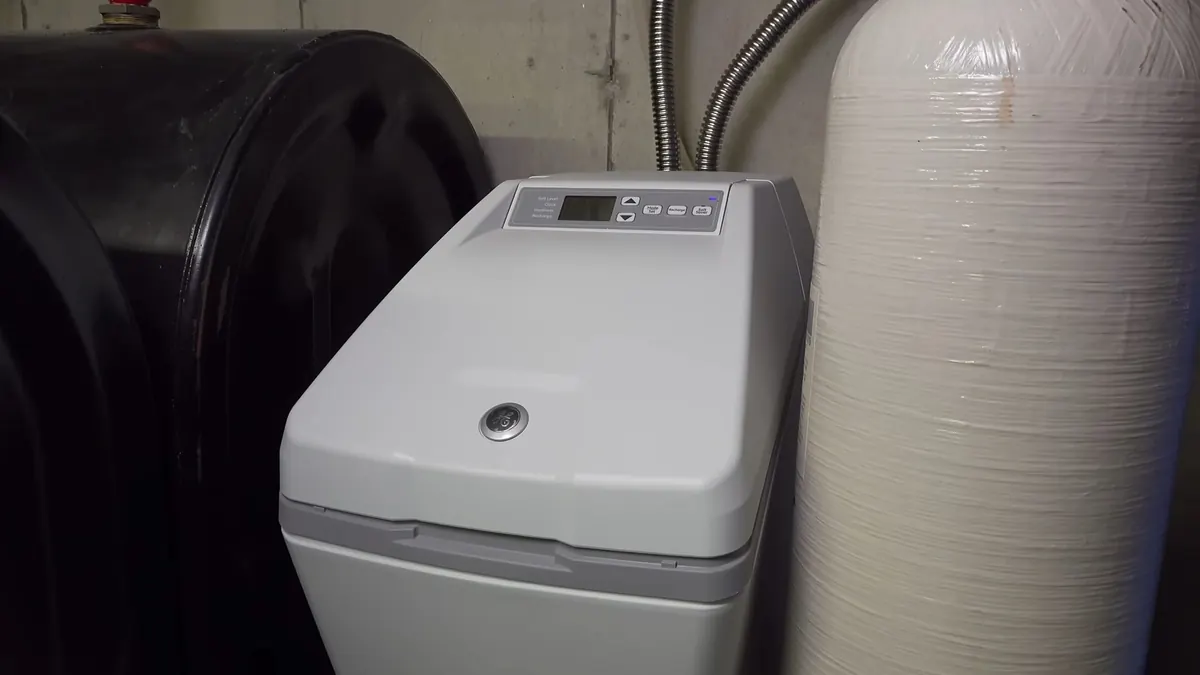
An ion-exchange water softener replaces calcium and magnesium ions in the water with sodium ions as the water passes through a resin bed. The finished water from the softener is soft: it does not scale heating surfaces, it lathers normally with soap and detergent, and it does not deposit mineral crust on fixtures. The resin bed is regenerated periodically with a salt brine, which restores its capacity.
For a typical Pottstown household at 150 to 220 ppm hardness, a water softener uses 8 to 12 bags of salt per year. High-efficiency demand-initiated regeneration systems use less salt than older timer-based models. The ongoing cost is roughly $100 to $175 per year in salt.
The water heater and appliance life extension from softened water is the primary economic case for a softener in Pottstown. A water heater that lasts 12 to 15 years on soft water versus 8 to 10 years on hard water, combined with lower energy consumption during operation, typically offsets the softener cost over its lifetime. Many homeowners also value the improvement in fixture appearance, soap performance, and skin and hair feel after bathing.
Frequently asked questions
Is Pottstown's water safe to drink? The hardness concern is about scale, not safety.
Yes. Hard water is safe to drink. The calcium and magnesium in Pottstown's water are naturally occurring minerals with no health concern at the concentrations found in PAW's finished water. The concern is entirely about scale effects on plumbing, water heaters, and appliances. A water softener addresses the scale problem but is not required for drinking water safety.
Does a water softener make the water salty-tasting?
No. A properly sized and calibrated water softener adds sodium in amounts that are not perceptible in taste. For a typical Pottstown household at 150 to 220 ppm hardness, the added sodium is roughly 20 to 50 mg per liter, well below any threshold of taste perception and within the range considered acceptable by health guidelines.
Should I soften the water going to my kitchen drinking tap?
This is a personal choice. Many homeowners prefer hard water at the kitchen tap for drinking and cooking, since the minerals are nutritionally neutral and some people prefer the taste. A common configuration is to soften the whole house supply but install a bypass at the kitchen cold tap so drinking water comes from the unsoftened supply. We can install this during the softener installation.
How long does a water softener installation take?
Most whole-home water softener installations take 3 to 5 hours including the connection to the main supply, bypass valve installation, drain connection, brine tank setup, and initial programming. We test the output hardness before leaving to confirm the system is working correctly.
Hard water scale taking a toll on your Pottstown water heater and fixtures? Free estimate for water softener installation.