Sewer line failure in Pottstown's older housing stock
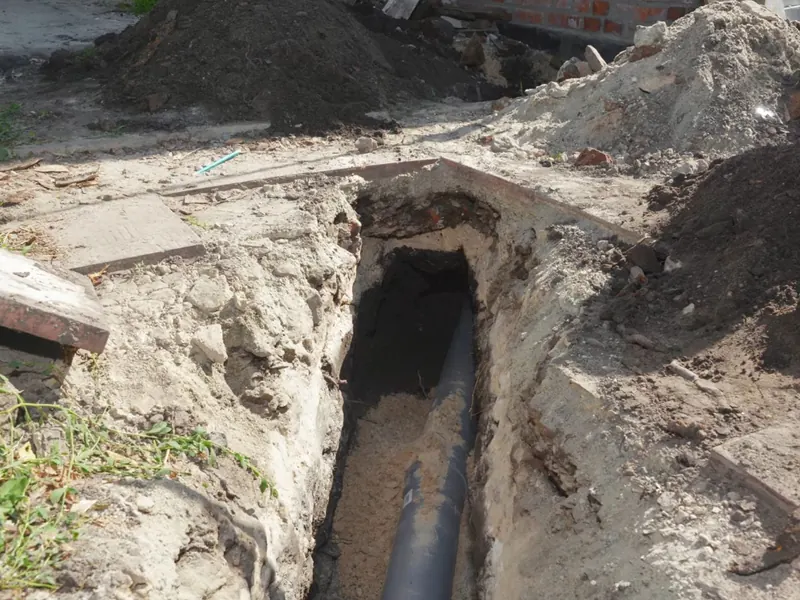
The sewer lateral is the pipe that runs from your home's drain stack to the municipal sewer main at the street. In Pottstown's pre-WWII housing, that pipe is almost certainly clay, which was the standard material for residential sewer laterals through the mid-20th century. Clay pipe is durable in stable soil conditions but has two significant long-term vulnerabilities: root intrusion through pipe joints and structural failure from ground movement.
After 80 to 140 years in the ground, clay laterals in Pottstown typically show one or more of these conditions: root masses at the bell-and-spigot joints where tree and shrub roots have entered over decades; offset joints where ground settlement or frost heave has shifted pipe sections out of alignment; cracked or spalled sections where the pipe has degraded; and reduced flow capacity from accumulated root debris and mineral deposits inside the pipe.
Cast iron sewer pipe was used in some Pottstown rowhomes for the interior-to-exterior transition, where the pipe exits the building at the foundation wall. These cast iron sections are also aging and can fail at fittings, cleanouts, and at the joint to the clay lateral outside.
Camera inspection before any sewer line repair
We don't recommend or price sewer line repair without camera inspection first. Camera inspection identifies the location, type, and extent of the damage before any excavation. This matters for two reasons: it allows us to price the repair accurately based on actual pipe condition rather than worst-case assumptions, and it prevents unnecessary excavation of sections that don't need repair.
The camera records video of the full lateral from the cleanout or from a toilet access point. We review the footage with you and explain what the images show: root entry points and their locations, joint offsets and their severity, cracks and their extent, and any sections of the pipe that are in adequate condition and should be left alone. This informs the decision between spot repair, full replacement, or trenchless CIPP lining.
Spot repair vs. full replacement
Spot repair addresses a specific failure point: an offset joint at a known location, a cracked 2-foot section at the base of the foundation wall, or a root entry point at a single pipe joint. The process involves excavating only the affected section, removing and replacing the damaged pipe length, and backfilling and restoring the surface. Spot repair makes sense when camera inspection confirms the rest of the lateral is in acceptable condition.
Full replacement is appropriate when camera inspection shows deterioration along most or all of the lateral run, when pipe offsets are severe enough that the pipe cannot drain properly even after clearing, or when spot repairs have been done repeatedly on the same lateral and the overall pipe condition has degraded to the point where continued spot repair is no longer cost-effective. See our sewer line replacement page for full replacement pricing.
Trenchless repair via CIPP (cured-in-place pipe) lining is a third option for laterals that are structurally sound enough to be candidates. Lining installs a new interior surface without excavation in most cases. See our trenchless sewer repair page for detail.
Sewer line repair costs in Pottstown
| Service | Typical Cost (Pottstown Area) |
|---|---|
| Camera inspection (standalone) | $200 – $450 |
| Spot repair, 2–4 ft section (accessible) | $500 – $1,500 |
| Spot repair with offset joint (deeper excavation) | $800 – $2,500 |
| Root intrusion clearing (hydro jet + root cut) | $300 – $650 |
| Interior cast iron repair at foundation | $600 – $2,000 |
| Cleanout installation (if not present) | $300 – $700 |
| Permit (Pottstown Borough Code Enforcement) | Included |
Estimates based on typical Pottstown area sewer repair scope. Camera inspection is required before we provide a repair estimate. Full lateral replacement pricing is on the sewer line replacement page.
Frequently asked questions
How do I know if I have a sewer line problem vs. a branch drain problem?
If one fixture is draining slowly or backing up, the problem is likely in the branch drain serving that fixture. If multiple fixtures are backing up simultaneously, especially if the basement floor drain is also showing signs, the problem is likely in the main sewer line. Multiple fixture backups during heavy use is a reliable indicator of a main line restriction or blockage that warrants camera inspection.
Does sewer line repair in Pottstown require a permit?
Yes. Pottstown Borough Code Enforcement requires a permit for sewer lateral repair and replacement. Work that connects to the municipal main also involves notification to the Pottstown Borough Authority. We handle permit filing and coordinate the inspection as part of the repair scope.
Can you repair a section of sewer pipe without excavating the full line?
Yes. Spot repair addresses an isolated cracked section, offset joint, or root entry point without excavating the entire lateral. Camera inspection identifies the exact location so we excavate only the affected section. Spot repair is appropriate when the rest of the line is in acceptable condition; if camera inspection shows wider deterioration, full replacement or CIPP lining is the better value.
How long does a clay sewer lateral typically last?
Clay sewer pipe has an estimated service life of 50 to 100 years. Pottstown's laterals from the 1880s to 1940s construction era are now 80 to 140 years old, which puts many past their functional lifespan. A lateral with a history of recurring blockages or that has never been inspected is worth a camera inspection before an emergency forces the issue.
Sewer line repair service areas
We repair sewer lines throughout Pottstown borough and the Schuylkill Valley. See also sewer line replacement, trenchless sewer repair, and camera inspection.