Trenchless Sewer Repair for Pottstown's Clay Pipe Laterals: When It Works and When It Doesn't
CIPP trenchless lining is a legitimate alternative to open-cut sewer replacement for many Pottstown clay laterals, but it doesn't work for every pipe. Here is how to know if your lateral is a candidate and what the cost comparison looks like.
Why Pottstown's clay laterals are at the center of this conversation
Clay sewer laterals installed in Pottstown's 1880s through 1940s construction are now 80 to 140 years old. These laterals connect each home to the municipal sewer main in the street using bell-and-spigot clay pipe joints that have been shifting, settling, and opening for a century. Root intrusion at those joints, combined with internal scale and in some cases localized cracking, makes these pipes the source of the recurring sewer backups and slow drain symptoms that Pottstown homeowners deal with.
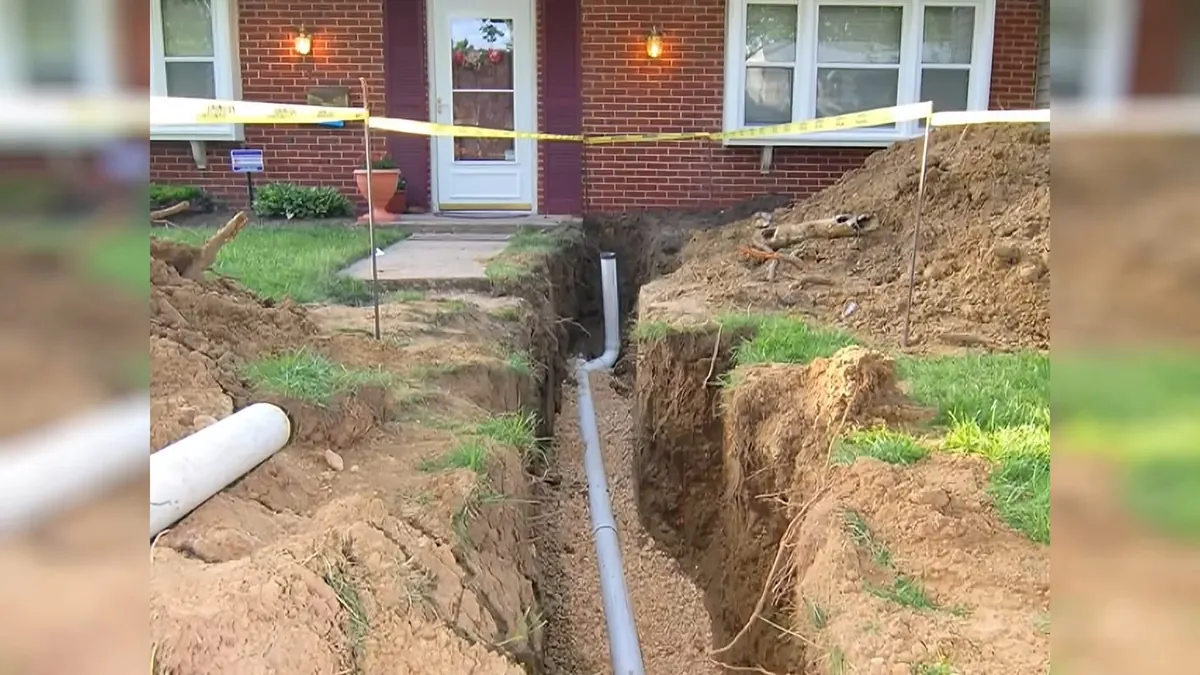
The traditional remedy is open-cut replacement: excavate a trench from the foundation to the street main, remove the old clay pipe, install new PVC, backfill, and restore the surface. It is effective, it is permanent, and it disrupts the yard, driveway, or sidewalk along the pipe run. CIPP (cured-in-place pipe) lining offers an alternative: install a new pipe inside the old one without excavation. The question is whether your specific lateral is a candidate.
How CIPP lining works
A felt or fiberglass tube saturated with epoxy resin is inserted into the existing pipe from a cleanout access point, typically at the foundation. The tube is inflated with air or water, pressing the resin-saturated liner against the pipe walls, and the resin is cured in place using heat or UV light depending on the system. The result is a continuous new pipe inside the old clay pipe, sealed at all joint points. Root entry paths are eliminated. The liner has an expected service life of 50 years or more.
The lining reduces the inside diameter of the pipe by the liner wall thickness, typically 6 to 12 millimeters. This has minimal hydraulic effect in most residential applications because the smooth interior of the new liner actually moves water more efficiently than the rough interior of the old clay pipe. Flow capacity is generally maintained or improved despite the diameter reduction.
When clay laterals are good CIPP candidates
A clay lateral is a good lining candidate when: the pipe is structurally present throughout the run (no collapsed sections); the pipe joints are not offset by more than about an inch (severe offsets prevent the liner from making full wall contact); root intrusion is the primary failure mode rather than structural collapse; the pipe grade has not sagged significantly (severe bellies collect debris and create backflow risk that lining does not address); and the pipe is cleanable by hydro jetting before the liner is installed.
Camera inspection before any work commitment is not optional; it is the only way to confirm candidacy. The camera assesses each of the above conditions section by section. In most Pottstown laterals we inspect, the pipe is a good candidate in some sections and marginal or non-candidate in others. The practical result is often a hybrid approach: open-cut spot repair of the specific collapsed or severely offset sections, followed by CIPP lining of the remaining lateral length.
When trenchless lining is NOT the right approach
Collapsed sections where the pipe no longer maintains its cross-sectional shape cannot be lined. The liner tube cannot pass through a true collapse and cannot be inflated to form a new pipe where the old one has caved in. Severely offset joints where sections have shifted more than roughly an inch are also problematic because the liner tube cannot make full contact at the offset point, leaving an unsealed gap.
Significant grade issues (bellies or sags) are not corrected by lining. A belly where the pipe grade has reversed accumulates solids and creates a recurrent blockage location. Lining a belly preserves the grade problem with a new pipe. Open-cut correction of the belly section is required for a lasting fix in these areas.
Cost comparison: CIPP lining vs. open-cut replacement in Pottstown
CIPP lining for a 50 to 70-foot Pottstown residential lateral runs $4,000 to $8,000 including camera inspection, hydro jetting before installation, and the liner itself. Open-cut full replacement of the same lateral runs $4,500 to $9,000 depending on depth, surface type, and whether concrete cutting is required. For shorter laterals in ideal conditions, lining can be less expensive. For longer or more complex laterals, the difference narrows. The primary non-cost advantage of lining is the absence of yard or driveway excavation.
Frequently asked questions
Is trenchless lining as permanent as open-cut replacement?
Yes, in terms of service life. CIPP liners are rated for 50 years or more of residential service. In terms of addressing the full problem, lining is permanent only for the failure modes it actually addresses: root intrusion and joint sealing. It does not correct grade problems, collapsed sections, or severely offset joints. A properly scoped lining project on a qualified lateral is a fully permanent solution.
Do I need hydro jetting before CIPP lining?
Yes, in almost all cases. The pipe interior must be clean before the liner is installed to ensure the resin bonds to the pipe wall rather than to a debris or root layer. Hydro jetting removes root masses, scale, grease, and debris. Some CIPP proposals that look inexpensive exclude the hydro jetting, which is a budget item that must be added before installation can proceed.
Can my clay lateral be lined if it has one collapsed section?
Not with lining alone. The collapsed section requires open-cut spot repair to restore the pipe cross-section. Once that repair is made, CIPP lining of the remaining lateral is often a viable approach. This hybrid is common in Pottstown lateral rehabilitation projects where a single isolated failure exists in an otherwise serviceable pipe.
How long does CIPP lining take compared to open-cut replacement?
CIPP lining of a typical Pottstown residential lateral takes 1 to 2 days including hydro jetting and curing time. Open-cut replacement of the same lateral takes 2 to 4 days. The time difference is significant for homeowners concerned about disruption, and the absence of yard or driveway excavation makes the aftermath cleanup much simpler.
Wondering if your Pottstown clay sewer lateral is a CIPP lining candidate? Camera inspection is the starting point. We provide recorded video and a clear recommendation.